
Compliance Overview 2024

The mission of the Office for Equal Opportunity Compliance (OEOC) is to promote a deep understanding and appreciation among the diverse members of the University community to result in justice and equality in educational, employment and contracting opportunities, as well as to lead efforts to create an inclusive academic and work environment. The Office for Equal Opportunity Compliance supports the University’s mission.

OEOC works to ensure that the University is compliant with non-discrimination and equal opportunity laws and regulations such as: Title VII of the Civil Rights Act of 1964; the District of Columbia Human Rights Act; Sections 503 and 504 of the Rehabilitation Act of 1973, as amended; the Vietnam Era Veterans’ Readjustment Assistance Act of 1974, as amended; the Americans with Disabilities Act of 1990, as amended; Title IX of the Education Amendments of 1972; the District of Columbia Protecting Pregnant Workers Fairness Act of 2014; the Equal Pay Act of 1963; the Age Discrimination in Employment Act of 1967; the Age Discrimination Act of 1975; Title VI of the Civil Rights Act of 1964; and the federal Pregnant Workers Fairness Act.

To uphold the University’s compliance with these laws and regulations, OEOC carries out the following responsibilities on behalf of the University: provides private consultation services; alternative resolution services to address issues of possible bias, discrimination, harassment, and related retaliation in lieu of, or as an initial step prior to, filing an OEOC complaint;  informal resolution services, including mediation, as a way to resolve allegations of harassment, discrimination, and related retaliation; investigates allegations of harassment, discrimination, and related retaliation; conducts administrative reviews and climate assessments; coordinates requests for accommodation based on disability, religion or pregnancy; maintains an Affirmative Action Program for Individuals with Disabilities and Protected Veterans in accordance with 41 C.F.R. § 60-300.44(a) and 41 C.F.R. § 60-741.44(a); provides training to the University community on relevant topics, such as implicit bias and bystander intervention; develops University policies and procedures related to equal opportunity, non-discrimination, and sexual misconduct; completes compliance reports; assists with the University’s supplier diversity efforts; and coordinates the response to bias-related incidents as a core member of the Bias Reporting Team. Additionally, OEOC’s Office of Title IX Compliance is responsible for upholding the University’s compliance with Title IX of the Education Amendments of 1972 and relevant federal and local laws against sex discrimination.

Accommodations
The Office for Equal Opportunity Compliance is responsible for coordinating the university’s response to accommodation requests in accordance with federal and District of Columbia laws, as well as university policies. The Office for Equal Opportunity Compliance provides accommodation assistance to applicants for employment and current employees, including staff, AAPs, faculty, student employees and visitors, in some instances.

Requests for accommodation may be based on disabilityreligion or pregnancy, childbirth or breastfeeding. Examples of workplace accommodations may include equipment or software; office furniture; the opportunity to take reasonable, periodic breaks; an alteration of the work schedule; access to a lactation room; or temporary relocation of a work space.

To request an accommodation, individuals are invited to contact the Office for Equal Opportunity Compliance in one of the following ways:

To request an accommodation, individuals are invited to contact OEOC in one of the following ways:

1. Submit an online request for
a: Disability accommodation
b. Religious accommodation
c. Pregnancy accommodation (based on pregnancy, childbirth, breastfeeding or a related medical condition)

2. Send an email to the Office for Equal Opportunity Compliance at oeoc@georgetown.edu

3. Call the Office for Equal Opportunity Compliance at 202-687-4798

OEOC considers each accommodation request individually and engages in an interactive process with the employee/applicant and the department. OEOC may request documentation to support an accommodation request and houses supporting documentation confidentially within OEOC.

To ensure that all requests for accommodations based on disability, religion, or pregnancy, childbirth, breastfeeding, or a related medical condition are given full consideration by the University, supervisors, managers, and department chairs may neither grant nor deny an accommodation without consultation with OEOC.

For more information about accessibility at Georgetown, please visit the University’s Accessibility website and the OEOC website.


Affirmative Action
With the full support of University leadership, and as required by law, Georgetown maintains an Affirmative Action Program for Individuals with Disabilities and Protected Veterans. The Program is designed to enhance the employment opportunities of qualified Individuals with Disabilities and Protected Veterans, and contains an audit and reporting system for measuring its effectiveness.

Further, in accordance with 41 C.F.R. § 60-300.44(a) and 41 C.F.R. § 60-741.44(a), Georgetown maintains a Policy and has practices applicable to Individuals with Disabilities and Protected Veterans. Georgetown University’s policy is not to discriminate against any faculty or staff, or any applicant for employment, on the basis of disability, protected veteran status, or any other class or characteristic protected by applicable federal, state, or local law. This Policy applies to all terms and conditions of employment, including recruitment, hiring, appointment, training, promotion, compensation, benefits, transfer, termination, education tuition assistance, and social and recreational programs.

Alternative Resolution
Alternative Resolution is a voluntary, collaborative opportunity to address issues of possible bias, discrimination, harassment, or related retaliation through a confidential non-investigative process, to build mutual understanding and promote healing. Any individual who believes that they may have experienced possible discrimination, harassment, or related retaliation in a Georgetown University program or activity, on- or off-campus, may request Alternative Resolution by sending an email to oeoc@georgetown.edu  or calling (202) 687-4798. Requests for Alternative Resolution are recorded in OEOC’s files.

Alternative Resolution is facilitated by a neutral OEOC staff member within a reasonably prompt time frame. Alternative Resolution may be used in lieu of, or as an initial step prior to, filing an OEOC complaint. OEOC encourages the use of alternative resolution, where appropriate.

Bias Reporting
Georgetown University has a rich tradition of embracing people from a wide spectrum of differing identities, including faith, race, ethnicity, culture, sexual and gender diversity, ability, socioeconomic status, and backgrounds. The University considers acts of hate and bias unacceptable and antithetical to its commitment as an inclusive and respectful community.

The purpose of the Bias Reporting System is to document and respond to bias-related incidents experienced by community members, including students, faculty, staff/AAPs, and to provide affected community members with support and resources. Through the Bias Reporting System, Georgetown tracks and reviews bias-related incidents, offers resources to impacted community members, identifies opportunities for educational programming, and shares information with reporting individuals regarding options for next steps. Reporting bias may lead to both informal and formal actions in response to concerns identified, including an investigation through one of the University’s formal grievance procedures, following which the University can hold accountable individuals found to have violated a University policy.

Please be aware, however, that while the expression of an idea or point of view may be offensive or inflammatory to some, it is not necessarily a bias-related incident. The University values freedom of expression and the open exchange of ideas. The expression of controversial ideas and differing views is a vital part of the University discourse. While this value of openness protects controversial ideas, it does not protect harassment or expressions of bias or hate aimed at individuals, where such expression violates University policies.

Climate Assessments
Climate assessments provide an opportunity for departments/units to gain an understanding of how faculty and staff experience and perceive their workplaces. OEOC generally conducts climate assessments through questionnaires and voluntary individual or group meetings with faculty and staff. Information obtained through climate assessments is kept private and results typically are shared in aggregate form, or in a de-identified manner. OEOC generally makes recommendations to the departmental or unit leader following a climate assessment.

Formal Complaints

OEOC reviews, investigates, and resolves alleged violations of the University’s Equal Opportunity and Non-Discrimination in Employment and Non-Discrimination in Education Policies, the Non-Discrimination on the Basis of Religion and National Origin Policy, the Policy Statement on Harassment (Relating to Protected Categories), the Policy on Sexual Misconduct, the Policy on Consensual Sexual or Romantic Relationships, and the Pay Transparency Non-Discrimination Statement.

If you believe you have experienced discrimination in violation of one of these policies, you may choose to file a complaint with OEOC. Please note that any faculty or staff member (other than those who are statutorily prohibited from reporting) who learns of conduct that may violate the University’s anti-harassment policy must contact OEOC at 202-687-4798, within 24 hours, or as soon as possible. If in doubt as to whether certain conduct violates this policy, or if you have any questions about this policy or its application, please call OEOC for a consultation.

To review the University’s Grievance Procedures or file a discrimination complaint with OEOC, please refer to the Grievance Procedures and the Discrimination Complaint Form. Additional information about OEOC complaint investigation and administrative review processes is available in OEOC’s Frequently Asked Questions document.

Allegations of discrimination, harassment, or related retaliation involving student-respondents are handled through the University’s Grievance Procedures to Investigate Allegations of Discrimination and Harassment against Students, which are a supplement to the Code of Student Conduct. These procedures are designed to provide for prompt, thorough, and equitable review, investigation, and resolution of formal complaints that involve allegations of discrimination, harassment, and related retaliation filed against University students, with the exception of Law Center students and School of Medicine students.

Applicants or Employees who believe they have been denied a job or an equal opportunity to apply for a job based on a disability, covered medical condition, or religion, refused a request for reasonable accommodation, or have been asked illegal medical questions or have been required to take an illegal medical examination may contact OEOC by phone at (202) 687-4798, by fax at (202) 687-7778, through our confidential email service at oeoc@georgetown.edu, or may choose to file a complaint with OEOC. Our office is located at 37th & O Streets, NW, M36 Darnall Hall, Washington, DC 20057.

Investigations & Administrative Reviews
OEOC investigates complaints over which it has jurisdiction; for example, complaints must allege conduct prohibited by a Georgetown University non-discrimination or anti-harassment policy and must be timely filed. To be accepted for investigation, a complaint must allege conduct, which, if substantiated, would constitute a violation of one or more of OEOC’s policies. Individuals who file complaints are encouraged to provide as much detailed information as possible, including when the reported incident took place and the reason for the reporting individual’s belief that the conduct falls within OEOC’s policies.

OEOC reviews administratively certain alleged violations of Georgetown’s institutional non-discrimination and anti-harassment policies, such as instances where an individual
chooses not to file a formal complaint but alleges serious or systemic conduct, which, if substantiated, could constitute a violation of an OEOC policy.

OEOC has the authority to initiate an administrative review at any time when, in the judgment of the Associate Vice President for Equal Opportunity, Civil Rights, and Compliance, such action is warranted. A department head or other University official may also request that OEOC conduct an administrative review, if this official becomes aware of alleged discrimination, harassment, or related retaliation.

Additional information about OEOC’s complaint investigation and administrative review processes is available in OEOC’s Frequently Asked Questions document.

Language Access & Diversity
Georgetown University celebrates language diversity and is committed to providing equal access to university services, programs, and activities. The university strives to create a culture of linguistic inclusion by increasing visibility of language diversity and supporting access to language assistance resources.

Schools and Departments are responsible for ensuring meaningful access to their programs, services, and activities to individuals in a timely, reasonable, and effective manner, in accordance with law. Language assistance is provided primarily through two key services: translation and interpretation. Translation refers to the written conversion of written materials from one language to another. Interpretation refers to the oral restating in one language of what has been said in another language.

The following university policies are available in multiple languages. If you need assistance with translations of other OEOC-related policies into additional languages, please contact us at oeoc@georgetown.edu.
Required Workplace Postings 
Policy Statement on Harassment

Individual Schools and Departments are responsible for arranging and paying for translation and interpretation services to ensure equal access to information, programs, and services, where required by law. 

Information about services provided by Deaf Access Solutions and best practices
Additional providers of translation and interpretation services
If you have questions about the process for arranging language assistance services, please contact the Office for Equal Opportunity Compliance at oeoc@georgetown.edu or 202-687-4798.

Title IX
Title IX of the Education Amendments of 1972 (“Title IX”) prohibits discrimination based on sex in any educational programs, which includes sexual harassment or any acts of sexual misconduct. Title IX requires the University, upon becoming aware of any incident of sexual harassment and misconduct to respond appropriately to protect and maintain the safety of the University community, including students, faculty, and staff. 
Georgetown University prohibits sexual misconduct, including sexual harassment, sexual assault, domestic/dating violence, and stalking.

Discrimination based on sex, including sexual misconduct and discrimination based on pregnancy or parenting status, subverts the University’s mission and threatens permanent damage to the educational experience, careers, and well-being of students, faculty, and staff.

The University provides resources for students, faculty, and staff/AAPs on issues relating to sexual misconduct, discrimination based on sex, and discrimination based on pregnancy, including options for getting immediate help; the University’s policies against sexual misconduct; how to report sexual misconduct; the University’s Sexual Misconduct Reference Guide; and campus initiatives

Data related to Title IX matters may be accessed in annual reports on the Title IX website: https://sexualassault.georgetown.edu/get-involved/annual-reports/.

Trainings and Educational Workshops
OEOC offers interactive, educational workshops to the Georgetown University community, upon request. To request one of the workshops below, please send a request to oeoc@georgetown.edu.

Available live workshops include:
– Active Bystander Intervention
– Bias Reporting System
– Diverse Recruitment and Hiring
– Employee Accommodations (for supervisors)
– Gender Identity and Expression
– Implicit Bias
– Mandatory Reporting (Title IX, Discrimination/Harassment)
– Microaggressions
– Planning Accessible Events
– Preventing and Addressing Sexual Harassment

Pre-Recorded Training: 
Title IX Mandatory Reporting Training

RESPECT Training:
Building Supportive Communities (Title IX and Clery)
– Preventing Harassment and Discrimination

Student Organization Training:
Community in Diversity: Understanding and Preventing Discrimination and Harassment

OEOC’s staff worked on a large number of matters during the 2024 calendar year. For example, OEOC worked on more than 664 formal complaints, administrative reviews, accommodation requests, bias reports, recruitment plans, alternative resolutions, informal resolutions, and educational workshops in 2024. 

In addition to these matters, OEOC responded to many other important matters not reflected in the summary below, including reports of compliance concerns, requests for consultation, and Title IX matters (for example, apart from the 664 matters reported above, OEOC’s Title IX Office received and responded to 183 reports of sexual misconduct from across our campuses during the 2024 calendar year). 
The data reflected in the pie graph below and the discussion that follows represent only a portion of OEOC’s work.
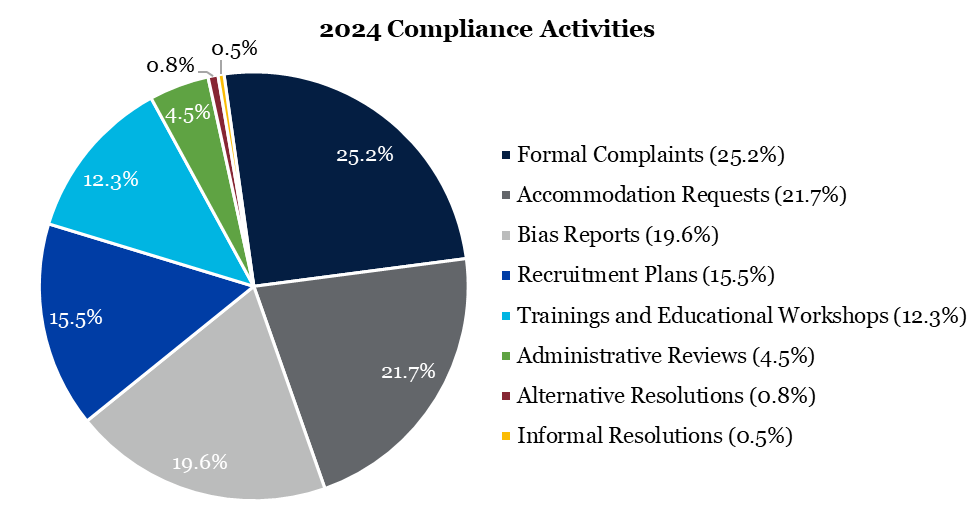

Pie chart illustrating that Formal Complaints constituted 25.2%, Accommodation Requests 21.7%, Bias Reports 19.6%, Recruitment Plans 15.5%, Trainings and Educational Workshops 12.3%, Administrative Reviews 4.5%, Alternative Resolutions 0.8%, and Informal Resolutions 0.5%  of reported compliance activities.

Formal complaints
OEOC received more than 96 formal complaints during the 2024 calendar year. Of the formal complaints filed:

Race, retaliation, and disability status were the most common bases for formal complaints.

  • 44 were filed by students or a student organization, 42 were filed by staff/AAP, 7 were filed by faculty, and 3 were filed by unnamed persons.
  •  47 formal complaints were filed against staff/AAP, 25 were filed against faculty, 12 were filed against students, 8 were filed against unnamed persons, and 4 were filed against the university.
  • Of the formal complaints filed against faculty, 60% were filed by students, 24% were filed by staff/AAP, 12% were filed by other faculty members, and 4% were filed by unknown persons.
  • Of the formal complaints filed against staff/AAP, 66% were filed by other staff/AAP members, 30% were filed by students, and 4% were filed by faculty.
  • Race, retaliation, and disability status were the most common bases for formal complaints.


    Bar chart illustrating that of the formal complaints filed in 2024, 44 were filed by students or a student organization, 42 were filed by staff/AAP, 7 were filed by faculty, and 3 were filed by unnamed persons.


    Bar chart illustrating that of the formal complaints filed in 2024, 47 formal complaints were filed against staff/AAP, 25 against faculty, 12 against students, 8 against unnamed persons, and 4 against the university.


    Pie chart illustrating that of the formal complaints filed against faculty members in 2024, 60% were filed by students, 24% were filed by staff/AAP, 12% were filed by other faculty members, and 4% were filed by unknown persons.


    Pie chart illustrating that of the complaints filed against staff/AAP in 2024, 66% were filed by other staff/AAP, 30% were filed by students, and 4% were filed by faculty.


    Row chart illustrating the bases on which formal complaints of discrimination, harassment, and/or related retaliation were filed in 2024. 49 formal complaints included race as an alleged basis, 38 included retaliation as an alleged basis, 31 included disability status as an alleged basis, 27 included sex/gender as an alleged basis, 23 included national origin as an alleged basis, 20 included religion as an alleged basis, 16 included color as an alleged basis, 15 included age as an alleged basis, 15 included political affiliation as an alleged basis, 13 included gender identity/expression as an alleged basis, 11 included personal appearance as an alleged basis, 10 included family responsibility as an alleged basis, 10 included sexual harassment as an alleged basis, 8 included matriculation as an alleged basis, 7 included marital status as an alleged basis, 7 included veteran status as an alleged basis, and 5 included genetic information as an alleged basis. Lastly, 25 formal complaints included an allegation of ‘other.’ Note: As formal complaints can allege more than one basis, the total number of bases illustrated in the row chart exceed the total  number of formal complaints.

    Administrative reviews
  • OEOC conducted 16 administrative reviews in 2024. Of these, 37.5% involved allegations about reported conduct by faculty members, and 37.5% involved allegations about reported conduct by staff/AAP. The remaining administrative reviews involved allegations about reported conduct by students or student organizations, and/or the university. The administrative reviews addressed claims of alleged discrimination, harassment, and/or related retaliation based on sex/gender, race, religion, national origin, color, sexual orientation, gender identity/expression, and disability status. Sexual harassment and race were the most common bases for administrative reviews.
  • During calendar years 2023 and 2024, OEOC conducted 26 administrative reviews. Due to the relatively small number of reviews conducted in 2024, results for 2023 and 2024 are presented here in the aggregate, to preserve confidentiality. Following careful review of the available information and the totality of the circumstances, in 39% of the administrative reviews that have closed, OEOC identified violations of policy, and in 30% of the administrative reviews that have closed, OEOC identified no violations of policy, but made recommendations to address concerns. Examples of outcomes of administrative reviews may include training/educational workshops, changes in procedures, implementation of safeguards, compliance monitoring, and referrals for potential disciplinary or corrective action.


    Pie chart illustrating that of the administrative reviews initiated by OEOC in 2024, 37.5% involved allegations about reported conduct by faculty, 37.5% about reported conduct by staff/AAP, and 25%  about reported conduct of other entities, including students, student organizations, and/or the university.

    Accommodation requests
  • OEOC facilitated approximately 121 new requests for accommodation based on disability, pregnancy, and religion filed by faculty, staff/AAPs, student employees, as well as applicants for employment. In addition to these requests, OEOC facilitated and monitored ongoing accommodation requests to ensure that they continue to meet the needs of employees and departments.
  • Disability accommodations: OEOC facilitated more than 88 disability accommodation requests from faculty, staff/AAPs, and student employees, as well as approximately 8 disability accommodation requests from applicants for employment.
  • Pregnancy accommodations: OEOC facilitated approximately 16 pregnancy or related accommodation requests from faculty and staff/AAPs.
  • Religious accommodations: OEOC facilitated approximately 9 religious accommodation requests from faculty, staff/AAP, and student employees.


    Pie chart illustrating that 79% of accommodation requests were based on disability, 13% were based on pregnancy, and 7% were based on religion.

    Educational workshops
    OEOC staff conducted more than 82 educational workshops across our campuses. Topics included Title IX education and awareness, implicit bias, active bystander intervention, and anti-discrimination, anti-harassment, and non-retaliation training, such as on topics covered under Title VI and Title VII of the Civil Rights Act of 1964.


    Pie chart illustrating that of the educational workshops conducted, 65% focused on Title IX, including topics such as reporting responsibilities, formal complaint options, and resources; 10% focused on anti-discrimination, anti-harassment, and anti-retaliation, including an overlay with speech and expression; 10% focused on OEOC and Bias Reporting;  6% focused on implicit bias; 5% focused on an assortment of topics, such as restorative circle training, and disability accommodations; 2% focused on active bystander intervention; and 2% focused on gender identity and expression. 

    Recruitment plans
    OEOC reviewed approximately 103 recruitment plans for faculty on the tenure-line and non-tenure line tracks, and approximately 31 recruitment plans for postdoctoral fellows and research fellows. For each recruitment plan, OEOC provided input to help diversify candidate pools and the Georgetown University workforce.

    Reports of bias-related incidents
    OEOC partnered with offices across our campuses to respond to more than 130 reports of bias-related incidents. The nature of bias-related incidents most often reported were religion, ethnicity, race, and national origin. For more information about the Bias Reporting System, including an overview of data regarding reported bias-related incidents, please visit: https://biasreporting.georgetown.edu/statistics/.

  • Title VI Canvas Course: In collaboration with campus partners from Student Affairs, CNDLS, OGC, and Communications, OEOC contributed to the development of a required Canvas course focused on preventing discrimination and harassment based on religion, race, ethnicity, and shared ancestry, consistent with Title VI of the Civil Rights Act as well as the D.C. Human Rights Act. The training explicitly addresses antisemitism and Islamophobia. The program began with a pilot rollout to more than 700 student organization leaders on Georgetown’s D.C. main campus. In Fall 2025, following the successful pilot phase, the University made the training requirement mandatory for all first-year undergraduate students, including first-year undergraduate students in GUQ, as part of their new student orientation to Georgetown. The training also provides information on how to report concerns and the supportive resources that are available to students who may be impacted by harassment or discrimination.  Students must successfully pass a quiz at the end of the program to complete this mandatory training.
  • Maintenance Connections: Working with the Department of Planning and Facilities Management, OEOC helped develop a process to streamline the reporting and response to maintenance requests related to an accessibility need.
  • Policies and Procedures: OEOC worked with campus partners to review a number of policies, including the Grievance Procedures to Investigate Claims of Discrimination and Harassment against Students (these procedures do not apply to Law and Medical students and are not used to resolve sexual misconduct matters).  
  • Resource Guide: Together with campus partners, OEOC developed a Resource Guide for Preventing and Responding to Harassment and Other Concerning Conduct Online. The resource guide provides information about the types of concerning conduct that may occur online; how such conduct may intersect with University policies; options for reporting online harassment and abuse; steps to protect oneself and mitigate risk online; and supportive resources at Georgetown and beyond.

Make a report

File a formal complaint


Request a meeting with an OEOC staff member


Request an accommodation


Speak with a confidential resource

  • Journey’s employee assistance program provides customized well-being resources through its digital platform as well as concierge-level support for individuals seeking therapy or coaching. Journey provides free mental health therapy and support for all benefits-eligible employees and their families in the Washington, DC, metro area, across the United States and internationally.


Report an accessibility barrier

(alpha order)

Sydney Adams
Deputy Title IX Coordinator and Civil Rights Investigator
sa2054@georgetown.edu 

Samantha Berner
Title IX Coordinator and Director of Title IX Compliance
Samantha.Berner@georgetown.edu

Mary Chlopecki
Senior Investigator and Counsel
mc2672@georgetown.edu

Rebecca Cpin
Director of Employment Equity Compliance & Data Analytics
Rebecca.Cpin@georgetown.edu

Sharrell McCaskill
Accessibility Manager and Civil Rights Investigator
sm3728@georgetown.edu

Bisi Ladeji Okubadejo
Associate Vice President for Equal Opportunity, Affirmative Action, and Compliance
Olabisi.Okubadejo@georgetown.edu

Cheryl Rost
Senior Civil Rights Investigator and Compliance Manager
cc1448@georgetown.edu

Ruby Smith
Office Administrator and Project Manager
ruby.smith@georgetown.edu

Tonya Turner
Associate Director
hindst@georgetown.edu

LaDreena Walton
Deputy Title IX Coordinator and Civil Rights Investigator
ladreena.walton@georgetown.edu 

Members of OEOC’s Intake and Care Management Team are available to speak with individuals who have questions about OEOC’s process. The Intake and Care Management Team conducts initial intake and assessment of formal complaints and reports of discrimination, harassment, and related retaliation. The Intake and Care Management team also offers information about supportive resources, facilitates requests for accommodation, and works with community members to resolve OEOC-related matters through non-investigative processes such as mediation.

Notice of Non-Discrimination
Georgetown University is committed to providing equal educational and employment opportunities and embraces the diversity of its faculty, staff, and students. Georgetown prohibits discrimination or harassment on the basis of any protected characteristic, as outlined below.  

Non-Discrimination in Education
Georgetown University provides educational opportunities without regard to, and does not discriminate on the basis of, age, color, disability, family responsibilities, familial status, gender identity or expression, genetic information, marital status, national origin, personal appearance, political affiliation, race, religion, sex, sexual orientation, source of income, veteran’s status or any other factor prohibited by law in its educational programs and activities.

Non-Discrimination in Employment
Georgetown University provides equal opportunity in employment for all persons, and prohibits unlawful discrimination and harassment in all aspects of employment because of age, color, disability, family responsibilities, gender identity or expression, genetic information, marital status, matriculation, national origin, personal appearance, political affiliation, race, religion, sex, sexual orientation, veteran’s status or any other factor prohibited by law.

Prohibition against Retaliation
Georgetown University prohibits retaliation, harassment, or other adverse action against an individual for making a complaint in good faith, assisting in an investigation, opposing harassment or otherwise exercising rights protected by law. It also prohibits taking any adverse academic or employment related action against an individual based on an unsubstantiated allegation or rumor of harassment. Retaliation should be reported promptly to the Office for Equal Opportunity Compliance and may result in disciplinary action up to and including dismissal.

Coordination of Compliance
The following person has been designated to handle questions regarding Georgetown’s non-discrimination and affirmative action policies:

Bisi Ladeji Okubadejo
Associate Vice President for Equal Opportunity, Civil Rights, and Compliance
Section 504, Americans with Disability Act, and Age Act Coordinator
Georgetown University
Office for Equal Opportunity Compliance
M-36 Darnall Hall
37th and O Streets, N.W.
Washington, D.C. 20057
202-687-4798

The following person has been designated to handle questions regarding Georgetown’s Title IX policy:

Samantha Berner, J.D.
Title IX Coordinator and Director of Title IX Compliance
Georgetown University
Office for Equal Opportunity Compliance
M-36 Darnall Hall
37th and O Streets, N.W.
Washington, D.C. 20057
(202) 687-4798

Individuals with inquiries regarding these policies are encouraged to first contact the employees listed above. Individuals with inquiries about Title IX may also choose to contact the U.S. Department of Education’s Office for Civil Rights.